What is Equine Thermography?
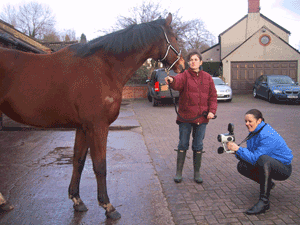 Thermal Imaging Inspection of a Horse
A thermal inspection is a non contact technique that provides a pictorial representation of the surface temperature of the horse’s body. Sensors within the camera convert infrared radiation (heat) emitted from the surface of the skin into electrical impulses that are shown on the image as areas of colour.
White represents the hottest temperature and is found on areas where there is major blood flow including parts of the face and the coronary bands, down through red, yellow, green to blue and finally black which represents the coldest areas. A blue streak indicating a lack of temperature can indicate pinching or pressure for example on a nerve root in the neck, while a pink or white area can indicate soft tissue, muscular or tendon damage.
As there is a high degree of thermal symmetry in the body, abnormal or asymmetrical changes which are usually indicative of a problem can be easily identified. An experienced Thermographer can interpret these images and advise the owner or trainer where there is an area of abnormal temperature, allowing a veterinary surgeon to diagnose and treat the problem
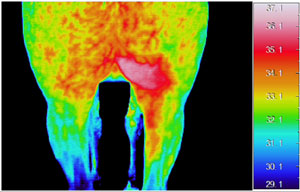 This horse slipped in a field and strained his semimembranosus muscle.
 The procedure only takes a few minutes, during which time the Thermographer examines the horse thoroughly through the camera lens. The horse is not touched during the inspection, making it ideal for young or nervous horses. The results of the inspection are instant, and the thermal images are left with the owner so that a full diagnosis can be made.
Used extensively since 1996 and approved by veterinary practices as an invaluable aid to assist diagnosis, the infrared inspection is carried out at the yard where the horse is kept. This ensures that the horse is relaxed and eliminates any stress which might be incurred during travel.
